20 Fascinating Dog Facts

Apr 8, 2026 | Pet Health, Pets, Tips and Tricks

Happy Wednesday, everyone!  I thought it would be fun to post these 20 Fascinating Dog Facts and see if you have heard of these before.  I hope everyone had a nice Easter and spent time doing something fun.  I cooked, and everything went as planned.  I made it easy for myself this year and baked everything in the oven at the same time.  Maggie got lots of attention and pranced around in her new bow from Naughty Paws.  I think I love getting her news bows in the mail as much as she does :-).

I like researching these fact-based articles for you, like the one I did here called Surprising Facts About Dog Kisses.


 
I found this article on Goodhousekeeping.com.  Comment below and let me know what surprised you the most and what you already know.  Enjoy!
 
1.  Dogs sweat through their toes
 
Dogs don’t just pant to cool off. “Dogs have sweat glands between their toes called merocrine glands, which, in addition to panting, are how they cool themselves down.  It’s one reason hot pavement can be so uncomfortable for them—those paw pads are doing more work than you think.
 
2.  Dogs can smell time
 
Because their sense of smell is so powerful, dogs can pick up changes in scent in their environment throughout the day. They can even sense that the air in your home smells different in the morning than in the evening.
 
3.  Oh, they know what they’re doing with those puppy dog eyes.
 
Puppy eyes are partially an evolutionary “trick” designed to tug at our hearts. Dogs have a special muscle above their eyes that their wolf ancestors don’t. It lets them raise their inner brows in a way that makes their eyes look bigger, softer, and more childlike.
 
That expression creates the irresistible “puppy dog eyes” look humans are hardwired to find cute and nurturing. Over time, dogs learned that this facial move gets our attention, affection, and often extra treats, too.
 
4.  Dogs can get sunburned.
 
Yes, just like us, dogs can get sunburned—especially on their nose, ears, and any areas where the fur is thin. Light-colored or short-haired dogs are particularly susceptible because they have less natural protection from the sun’s UV rays.
 
Redness, tenderness, or peeling can all be signs of sunburn, just like in humans. For beach days, hikes, or long stretches in direct sunlight, vets often recommend using a pet-safe sunscreen and offering plenty of shade and fresh water to protect your pup.
 
5.  Jumping on people is actually a normal dog behavior.
 
That overexcited greeting at the door isn’t your dog trying to act up.  Jumping up or on people is normal; the dog is just excited.
 
6.  Aging dogs often get new nighttime fears.
 
If your senior pup suddenly seems anxious after dark, it might be more than quirkiness.  They often sleep more or develop new fears, typically at night, because their vision may deteriorate or their cognition is declining.
 
7.  Dogs can be right- or left-pawed.
 
Just as humans are typically right- or left-handed, many dogs show a clear preference for one paw when stepping forward, offering a high-five, or steadying a favorite toy on the floor. You can test this by watching which paw your dog uses first during play or training over several days. With a little patient observation, you’ll quickly figure out whether your pup is a righty or a lefty at heart.
 
8.  A wagging tail doesn’t always mean your dog is happy.
 
Tail wagging is dog language, but context matters a lot more than many pet parents realize. A loose, sweeping wag that moves the whole backside usually signals joy and friendliness. A stiff, high, fast wag can mean your dog is on high alert, overstimulated, or feeling unsure.
 
9.  A dog’s noseprint is totally unique to them.
 
Your dog’s nose print is as unique as a human fingerprint, right down to the tiny bumps and ridges. Just like with cats, no two dogs have the exact same nose pattern, even if they’re from the same litter.
 
10.  Saying “no” isn’t very helpful to dogs.
 
We may default to “no!” when our dog does something we don’t like, but it doesn’t give them a clear path to success.  Positive reinforcement works best.
11.  Clear cues and rewards work much better.
 
So, what should you say instead of “no”?  When they are doing something you don’t want them to do, you can give them a time-out with a safe place to rest, like their kennel, or say ‘leave it,’ and reward them right away when they do what it is you want them to do.
 
12.  They understand dozens of words.
 
Dogs can understand dozens of human words—far more than many people realize. Many family dogs can learn 50 to 100 words or more, especially names of people, favorite toys, and daily routines like “walk,” “treat,” or “car.”
 
With repetition and clear associations, they build a little vocabulary over time. Some exceptionally trained dogs have even been known to recognize hundreds of words and the names of objects, proving just how closely they listen to the humans they love.
 
13.  Dogs are deeply empathetic.
 
Your dog isn’t just picking up on your mood—they may be syncing with it.  Dogs mirror our feelings and are extremely in tune with our emotions; through a heart-rhythm synchronization (entrainment) and energetic relationship, a coherence occurs between their hearts and that of their guardian.  This coherence shows they have empathy and the ability to attune emotions.
 
14.  Licking their feet can be a big red flag.
 
Occasional paw grooming is normal, but licking their feet for extended periods of time.  This can be an indication of pain, a way to soothe nerve endings, a coping mechanism, or a sign of allergies and disharmony in the body.
 
15.  Humping is usually emotional, not “naughty.”
 
Yes, the air-humping or stuffed-animal-humping behavior can be awkward, but it’s rarely just bad manners.  People often gasp when they see dogs hump the air, another animal, an object, or a human.  But it’s typically a way of releasing bottled-up energy or coping with emotions or excitement from over-stimulation.  Often, what your dog needs is more movement and better outlets, not scolding.
16.  Your dog’s tongue is a powerful health clue.
 
Traditional Chinese veterinary medicine (TCVM) uses the tongue as a window into the body.
 
Their tongue can be very telling.  A red tongue means there is excess heat that needs to be cleared (i.e., toxin, infection, or trauma), a wet, pale purple tongue is associated with too much yin or cold associated with slow moving energy and signs like edema…[and] a thick white coating can be related to digestion issues or damp/phlegm accumulating in the body.
 
17.  Dogs’ hearing is much more sensitive than humans’.
 
Those adorable ears are incredibly sensitive and powerful tools. Dogs can hear much higher-pitched sounds than we can, and at far greater distances, which is why they often react to things like delivery trucks, squirrels outside, or distant thunder long before we notice anything at all (and why these noises might trigger anxiety).
 
They’re also experts at picking up the tiniest changes in sound at home—the jingle of your keys, the fridge opening, or the garage door starting to move can all be instant “alerts” in your dog’s world.
 
18.  A quick walk isn’t enough exercise for most dogs.
 
That morning-and-night loop around the block might not cut it for your pup’s body or brain.  It’s often assumed that dogs only need a walk in the morning and at night.  The reality is that dogs need the opportunity to move freely daily, like running in a field or at a dog park, so they can release pent-up energy and stay in shape.
 
19.  They have specific ways of comforting us when we’re upset.
 
When you’re sad or stressed, your dog may have a built-in toolkit to help you calm down.  They will often sit next to us, put their heads on our hearts to calm us, or lick us to console us and help bring us back to center.
 
When you’re joyful, they mirror that too:  They will often mirror us by having their mouth open in a smile, sometimes with tongue hanging, pant with excitement, jump in the air, make circles, or wiggle their bodies while wagging their tail.
 
20.  Dogs do dream… and probably about you!
 
If your dog’s paws twitch, their whiskers wiggle, or they let out tiny “woofs” in their sleep, they’re likely in the middle of a dream. Studies suggest dogs process their day during sleep, just like we do, moving through similar sleep stages.
 
That means they may be replaying familiar routines like walks, playtime, mealtimes, or cozy snuggle sessions with you, starring you as a main character in their dream world.

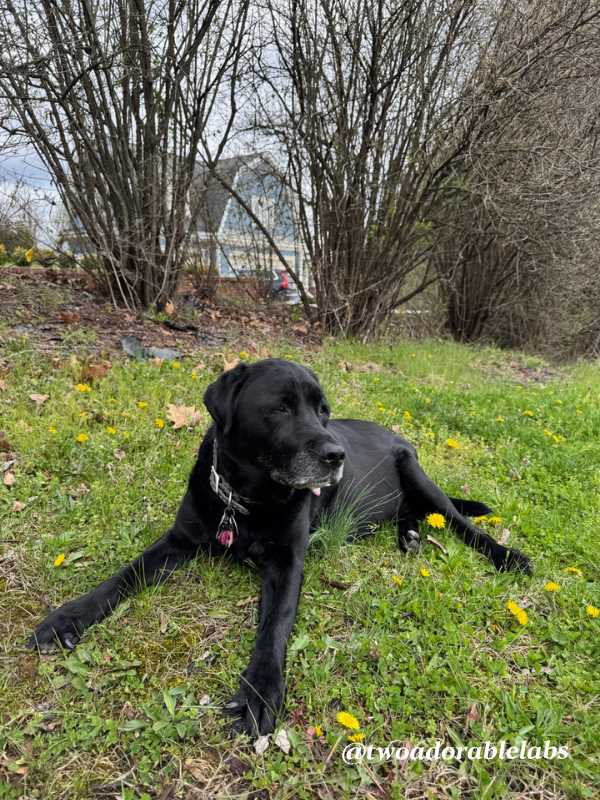
Maggie enjoying some spring weather!

Maggie and I go for a walk every day, sometimes twice a day, and she loves resting and looking over our property.  Sometimes she finds a bug in the grass and watches it for what feels like forever!  LOL :-). I bought new bows for Easter and spring, and I show them here.  Check out Naughty Paws and use code “TWOADORABLELABS10”  for 10% off your order.  Oh…and we got her first Magnolia flower blooming!  I love our Magnolia shrubs :-). 

I’m Bobbi Jo, a lab-lover who took my passion for animals and dogs and turned it into something bigger.  When I adopted Jake and Maggie, my love for them became the driving force behind Two Adorable Labs, and my blog was born.  My hope is to not only share them with the world, but to help educate others on the importance of animal health and well-being.

Two Adorable Labs has become a collection of all that I love.  I’ll send one post each week on things that bring me joy on animal health, home decor, and food recipes for humans and our furry friends.  I hope you enjoy these posts and much as I do creating them!

I love hearing from all of you and do my best to respond to each and every one of you.  I always enjoy your comments, feedback, and suggestions so keep them coming!  If I’ve posted a recipe (for our human and our furry friends) and you try it, don’t forget to tag me on Instagram @twoadorablelabs and use #twoadorablelabs​.

If you do try and love my recipes, I would greatly appreciate a comment and rating.  I read every single one and respond to them.  It also lets Google know that the website contains quality content.  The more comments and 5-star ratings, the more Google will show my blog in search results!  Thank you so much!

As an Amazon Associate, I earn from qualifying purchases.

Jake and Maggie are now proud Ambassadors for Ava’s Pet Palace.
Log on to avaspetpalace.com/twoadorablelabs for 20% off your order!

Love, Jake and Maggie

You Might Also Like

Can Dogs See In The Dark?

Can Dogs See In The Dark?

Happy Wednesday, everyone!  Can Dogs See In The Dark?  I was walking with Maggie into the house this morning.  It was dark outside, and I had forgotten to turn the lights on in the garage and mudroom.  She was walking ahead of me with no problem at all, and I was...

Maggie’s Nystagmus And Osteoarthritis

Maggie’s Nystagmus And Osteoarthritis

Happy Wednesday, everyone!  On Monday, we took Maggie to the Ohio State University Veterinary Medical Center for our surgeon to evaluate her ankle.  Before leaving for Columbus, Maggie had a transient episode of Nystagmus. Nystagmus in dogs is an involuntary,...
What Is the “777” Rule For Dogs?

What Is the “777” Rule For Dogs?

Happy Wednesday, everyone!  What is the "777" rule for dogs?  The 777 Rule for Dogs is a simple guideline that helps adopters understand what to expect when bringing a new dog home—especially from a shelter or rescue.  It reminds you that adjustment takes time and...

5 Different Dog Cuddling Styles and What They Mean

5 Different Dog Cuddling Styles and What They Mean

Happy Wednesday, everyone!  Do you have a dog who loves to snuggle, or one who gives you a minute or two of attention and then walks away?  Do you think Dogs Snuggle With their Alpha?  This article, based on research and from www.paradepets.com, on the 5 Different Dog...

What Do You Think? Let Us Know!

0 Comments

Submit a Comment

Your email address will not be published. Required fields are marked *

This site uses Akismet to reduce spam. Learn how your comment data is processed.

Crop Image